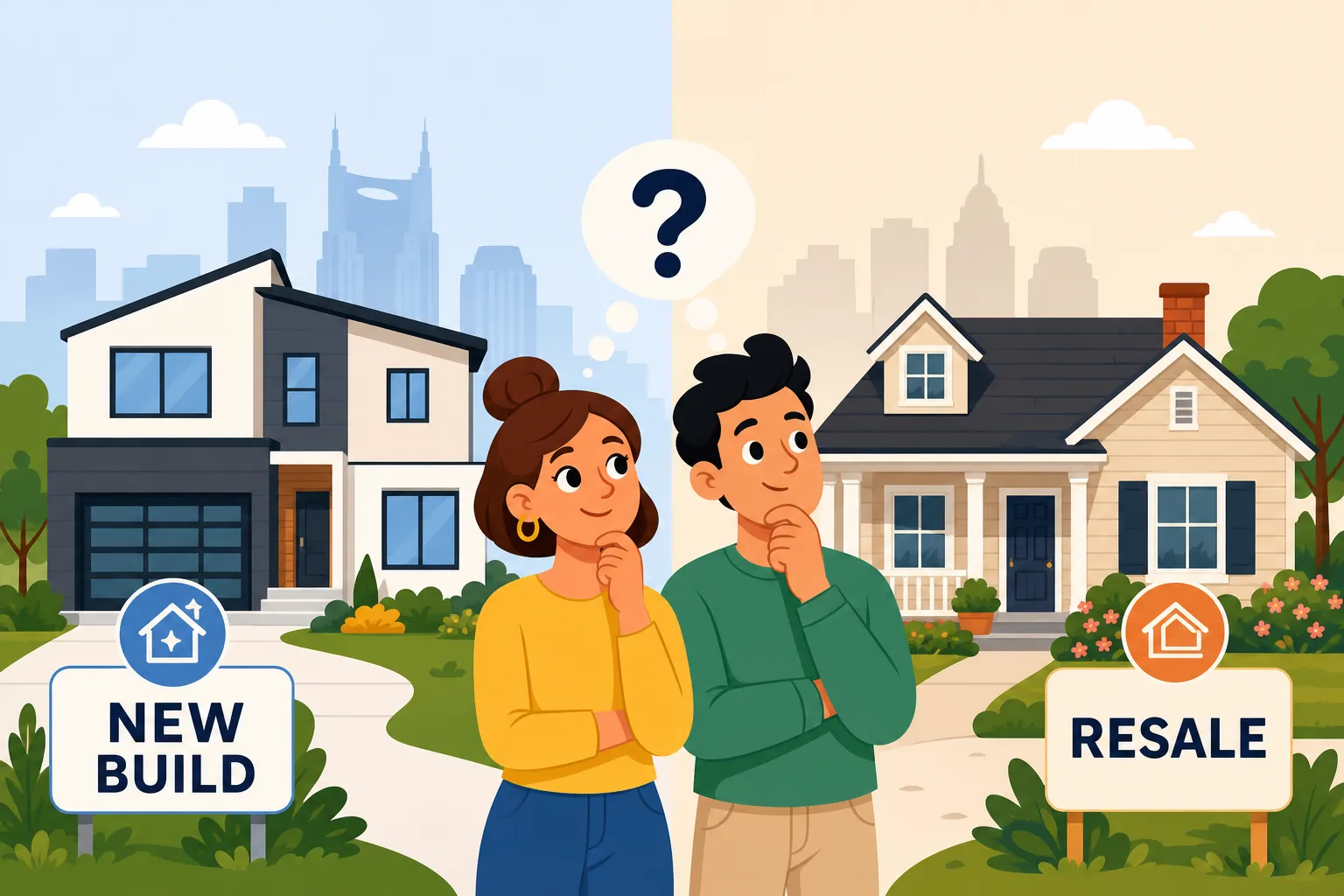
Picture this: you have two browser tabs open. One shows a brand-new community in White House, TN, with fresh sidewalks, a sparkling model home, and a move-in date that's six months away. The other shows a well-loved brick ranch in Franklin with mature trees, a fenced backyard, and a price tag $55,000 lower. Both look pretty good. Both have real tradeoffs. And you're sitting there wondering which one is actually the smarter move.
If you're asking yourself, "Should I buy a new construction or existing home in Nashville?", you're not alone. It's one of the most common questions I hear from clients states Kathy Simms with Your Greater Nashville Real Estate. The honest answer is that neither option is universally better. What matters is which one fits your timeline, budget, and life plans. Here's what the real data on costs, timelines, warranties, and long-term value actually shows, so you can stop second-guessing and start moving forward.
Should I buy a new construction or existing home in Nashville? Start with the price gap
The sticker price difference between new construction and existing homes in Nashville is real, but the full picture is more nuanced than the listing price suggests. Understanding what drives that gap helps you decide whether you're paying for something valuable or simply paying more.
What Nashville's price-per-square-foot data reveals
As of mid-2026, new construction homes in Nashville average $301 to $304 per square foot, while existing homes sit closer to $276 per square foot. On median-priced homes, that translates to a new build listing around $530,000 versus a resale sale price near $475,000. The gap reflects newer systems, energy efficiency, and zero deferred maintenance at move-in. Those benefits are real, but they don't always justify a $55,000 premium for every buyer.
Closing costs, lot premiums, and builder upgrades that change the math
New construction carries buyer costs that resale transactions don't. Closing costs on a new build run 2% to 4% of the purchase price, that's $9,000 to $18,000 on a $450,000 home. Lot premiums for desirable locations (a cul-de-sac, a greenway-backing lot, or a larger footprint) can add $5,000 to $50,000 on top of the base price. Upgrade packages at the design center can easily run another $20,000 to $30,000 beyond what the model home showed you.
On the other side of the ledger, Nashville builders are actively offering incentives right now: closing cost credits ranging from $5,000 to $50,000, rate buydowns, and design center allowances. Resale buyers, meanwhile, typically have negotiation room and can request inspection-driven repairs or seller credits. Both paths have ways to reduce your out-of-pocket costs. The key is knowing which levers to pull, and having someone in your corner who knows how to use them.
Move-in timelines: how long will you actually wait?
Timeline is often the deciding factor for buyers with lease expirations, school enrollment deadlines, or job relocations. The word "new construction" covers a wide range of situations, and the difference in wait times between them is significant.
Spec homes vs. to-be-built: the timeline spread
A spec home, meaning a home already under construction, can close in 30 to 90 days, similar to a standard resale transaction. A to-be-built production home in Nashville's suburban communities typically takes 6 to 10 months from contract signing to closing. A fully custom or semi-custom home with a design phase can stretch to 12 to 18 months. When a buyer tells me they want a "new home," I always ask which of these three they're actually imagining, because the experience is entirely different.
What causes delays in Nashville new construction
Middle Tennessee has some delay culprits specific to this market. Permit backlogs in fast-growing suburbs like Spring Hill and White House can slow approvals by weeks or months. Heavy rainfall delays grading and foundation work. Subcontractor demand peaks in spring and summer, compressing scheduling. And mid-build design changes, the kind that seem small when you request them, require revised plans, new permits, and material reorders that ripple through the whole timeline.
Resale transactions aren't immune to friction either. Buyer financing hiccups, title issues, and inspection negotiations can all push a closing date. But the timeline is generally more predictable once you're under contract, which matters a lot if you're working around a specific life event.
Warranty coverage and who handles repairs after closing
One of the biggest misconceptions I hear from buyers is that buying new means buying worry-free for the foreseeable future. That's mostly true, but warranty coverage has structure, conditions, and limits worth understanding before you close.
How Nashville builder warranties are structured
The standard builder warranty in Nashville follows a tiered structure: one year for workmanship and materials, two years for systems coverage including electrical wiring, plumbing pipes, and HVAC ductwork, and ten years for major structural defects. Major Nashville-area builders use third-party providers like 2-10 Home Buyers Warranty, which is insurance-backed, HUD-approved, and fully transferable to a future buyer, a feature that actually adds resale value down the road.
Keeping that coverage valid is on you as the homeowner. That means notifying the builder promptly when you spot a defect, granting access for repairs during business hours, and following the maintenance booklet that comes with your home. If you skip HVAC filter changes or let gutters go unattended, the builder has grounds to deny related claims. Read the maintenance booklet. Keep records. It sounds tedious, but it's the difference between a covered repair and an out-of-pocket one.
What resale buyers need instead
Existing homes don't come with a builder warranty, but a thorough home inspection combined with a home warranty policy can provide meaningful protection on systems and appliances. On an older Nashville home, inspection quality matters more than it does on a new build. Specifically, you want a qualified inspector paying close attention to HVAC age and condition, roof integrity, and crawl space moisture, a common issue in Middle Tennessee's climate.
A well-inspected, well-maintained resale home in a strong Nashville suburb can be a genuinely smart buy. The key word is "well-inspected." Don't skip it, don't rush it, and don't use a family friend who does it on weekends.
Customization, maintenance costs, and what "move-in ready" really means
Both new builds and resale homes can be move-in ready on day one. What differs is how much say you had in the finishes before you moved in, and what you're likely to spend in years two through ten.
How much customization you actually get with a new build
There's a spectrum here that buyers don't always realize exists. Spec homes offer limited or no customization since the finishes are already selected. Production homes, which make up the majority of new communities in Nashville's suburbs, let you choose from design center packages within set parameters. Fully custom builds give you real creative control, but at a significantly higher price point and longer timeline. If you're imagining a completely bespoke floor plan from a builder community in Spring Hill or White House, it's worth having an honest conversation about what flexibility actually looks like in that community before you fall in love with the model home.
The maintenance reality of older Nashville homes
Resale homes, particularly those built before 2005, often carry costs that don't show up in the first month. Aging HVAC systems, older roofing, outdated electrical panels, and original plumbing are the usual suspects. Budget 1% to 2% of the home's value annually for maintenance and improvements on an older property. That's $4,750 to $9,500 per year on a $475,000 home, and it's a realistic number. New construction keeps those costs low for the first five to seven years, which is a genuine financial advantage, especially for buyers who are stretching their budget at purchase.
Resale value and appreciation: which holds up better in Nashville?
Both new construction and existing homes have appreciated strongly in Nashville over the past several years. The more interesting question is what's driving those appreciation rates and what they mean for your specific situation.
What Nashville's appreciation trends show
New construction in Nashville appreciated approximately 27% over the past five years, driven largely by supply constraints. Nashville builders produce only about 1,450 new homes annually, a number that has stayed relatively flat while demand has grown significantly. Construction costs have risen roughly 15% in the past two years, which puts a natural floor under new-home pricing. Existing home prices rose 4.8% year over year in 2025, with more modest gains of around 0.5% in early 2026. Both segments have shown strength, but the new construction premium is backed by real supply and cost dynamics.
Neighborhood stability vs. new community growth
An established resale neighborhood in Franklin or Brentwood offers something a new community can't yet deliver: proven school performance, walkable character, and infrastructure that's already mature. A newer corridor in White House or Spring Hill often offers more square footage per dollar and appealing community amenities, but long-term appreciation depends on how that area develops over the next decade. At Your Greater Nashville Real Estate, Kathy Simms works across both types of markets and help buyers map each option against their actual 5- to 10-year plans, not just the current price tag.
Should I buy new construction or an existing home in Nashville? Four questions to ask yourself first
Pulling this together comes down to four honest questions worth asking before you tour another home or visit another model center. Your answers will point you in the right direction faster than any listing comparison will.
- Is your timeline non-negotiable? A resale home or a spec new build is your path. Waiting 10 months for a to-be-built home when your lease expires in four months is a recipe for stress, not excitement.
- Do low maintenance costs and warranty protection top your list? New construction is worth the premium, especially if you're a first-time buyer who doesn't want the surprise of a $6,000 HVAC replacement in year two.
- Is budget your primary constraint? An existing home in a strong Nashville suburb often delivers more square footage per dollar and puts you in an established neighborhood with known values.
- Do modern design and customization matter most? A to-be-built production or custom home is the right fit, as long as you plan for the longer runway and understand the design center process before you sign a contract.
A short checklist before you commit
Regardless of which direction you're leaning, these steps apply to every Nashville buyer:
- Get pre-approved before you tour. Builders have preferred lenders and can move fast. Know your numbers before you're in the room.
- Request a full cost breakdown. Ask for upgrades, lot premiums, and closing costs, not just the base price on the sign out front.
- Schedule an independent home inspection on new builds. Even new construction has defects, and a third-party inspector works for you, not the builder.
- Work with a local buyer's agent who represents your interests. Builder sales agents are professionals at their jobs. Having your own advocate in the room changes the dynamic entirely.
At Your Greater Nashville Real Estate, I provide buyer representation for both resale and new construction purchases across Greater Nashville, from established Franklin neighborhoods to new communities in White House and Spring Hill. My job is to help you evaluate each option against your real priorities, not the marketing.
The bottom line on Nashville new build vs. resale
New construction offers warranties, modern energy efficiency, and lower early maintenance costs, at a higher price point and longer timeline. Resale homes offer established neighborhoods, negotiation flexibility, and faster closings, with more maintenance responsibility as the home ages. Neither is universally better. The right answer lives at the intersection of your timeline, budget, lifestyle, and long-term plans.
If you're still weighing whether to buy a new construction or existing home in Nashville, you can only learn so much from browser tabs. The nuances of specific communities, builder reputations, neighborhood trajectories, and true total costs only become clear when you're talking to someone who walks these neighborhoods every week. I'd love to be that person for you. Reach out to Kathy Simms at Your Greater Nashville Real Estate for a no-pressure conversation, and let's figure out which path actually makes sense for where you're headed.