Buying land to build a house in Tennessee: 2026 guide
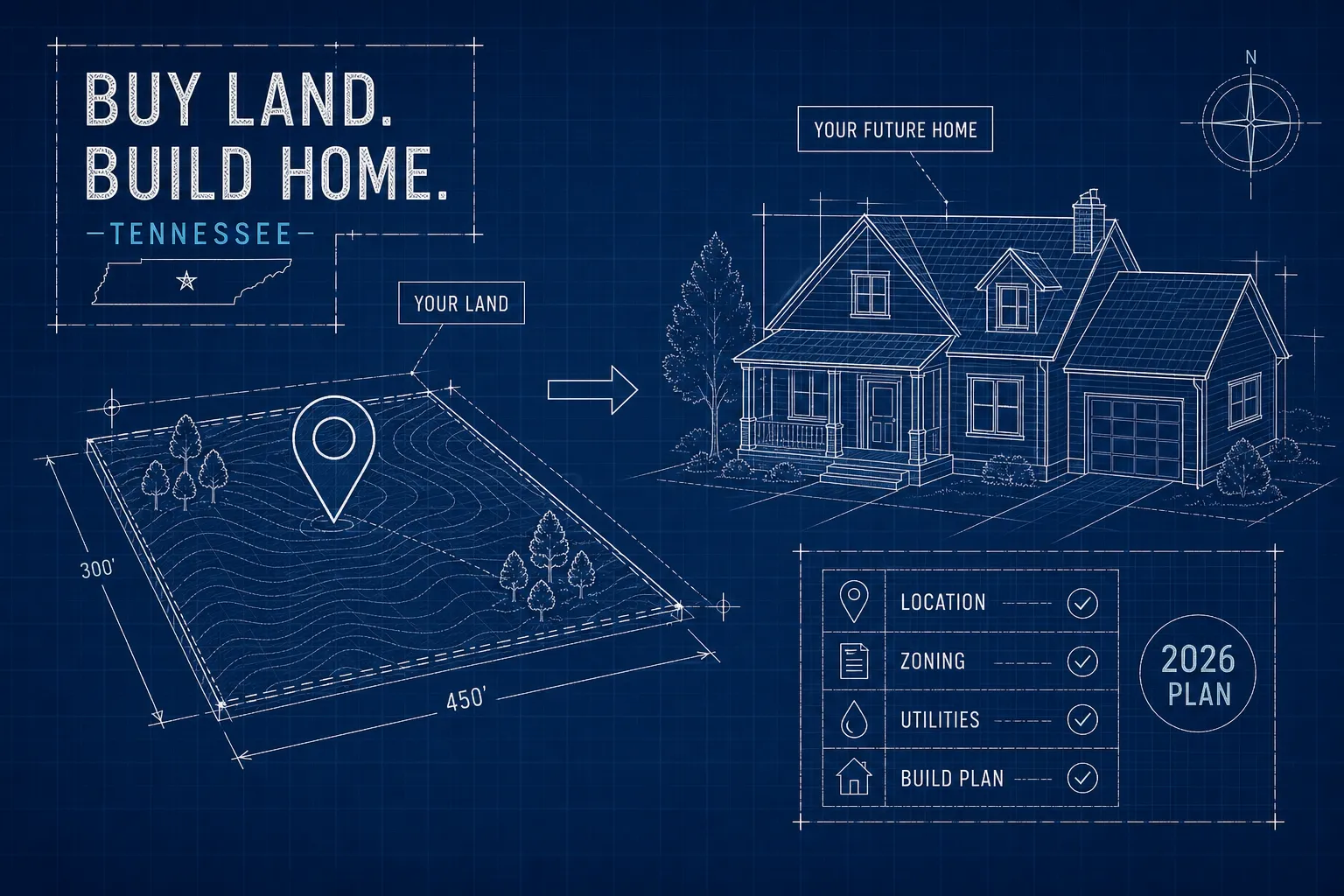
Buying land to build a house in Tennessee starts with more due diligence than most buyers expect. Falling in love with a piece of land is easy, the rolling acreage, the tree line at the back of the property, the way the light hits at dusk. What those moments don't reveal is whether the soil will pass a perc test, whether a flood zone boundary cuts through the middle of your intended build site, or whether any legal road access actually exists. Some buyers across Middle Tennessee have signed a contract on raw land only to discover one of those problems after closing. This guide is about preventing that.
At Your Greater Nashville Real Estate, Kathy Simms explains that land evaluation questions come up constantly from buyers across Greater Nashville and Middle Tennessee. The answers matter long before you make an offer. Work through this 2026 checklist to assess a parcel's true buildability before you commit your money or your plans.
What "buildable" actually means for a Tennessee parcel
Most raw land listings look promising. What they don't show is the legal and regulatory framework that determines whether you can actually place a home on the property. There are three layers to check before anything else.
Tennessee zoning authority applies only to unincorporated areas outside municipal boundaries, governed under Tennessee Code Title 13, Chapter 7. Zoning rules are county-specific, and they vary significantly. Knox County, for example, requires a minimum 1-acre parcel for certain residential uses. Williamson County adopted a Zoning Ordinance in 2012 that governs density, setbacks, and open space in unincorporated areas, with additional changes made in 2021 to reduce development density. Contact the Planning Department for the specific county where the parcel sits, pull the official zoning map, and confirm the permitted residential uses before you write an offer. If you're shopping in the Franklin area, you can also review available local options such as Brentwood Land for Sale to get a sense of current pricing and lot types.
Flood zone status is the second check. A parcel in FEMA Flood Zone A or AE is not automatically unbuildable, but it triggers mandatory flood insurance and typically raises construction costs substantially. Use the FEMA Flood Map Service Center at msc.fema.gov to search by address and download a FIRMette. Tennessee also maintains a Property Viewer with FEMA flood overlays covering 85 of the state's 95 counties, which is a faster starting point for most searches.
Easements and deed restrictions are where buyers get caught off guard most often. Utility easements, road easements, and deed covenants run with the land and survive ownership changes. They can restrict where you build, how large your home can be, and what structures are allowed. These don't appear on flood maps or zoning ordinances, they live in deed records at the county Register of Deeds. A title search by a real estate attorney or title company is the only reliable way to find them before you close.
Buying land to build a house in Tennessee: soil, septic, and well
If a parcel doesn't connect to public sewer, and most rural and semi-rural Middle Tennessee lots don't, the soil itself has to function as your wastewater system. This is where a lot of land purchases stop moving forward.
Perc test basics and sizing
A percolation test, performed by a state-licensed soil scientist, measures how fast water moves through the soil and determines whether a septic drainfield can work on the property. Required drainfield square footage per bedroom depends on soil type: gravel or sandy soils may need as little as 100 square feet per bedroom, loam around 200, and clay soils can require up to 300 square feet per bedroom, though the exact figures follow TDEC's soil classification tables, so confirm current sizing with your county Environmental Health office. Heavy clay with slow percolation rates can prevent approval of a conventional septic system entirely, pushing you toward engineered alternatives like mound systems or aerobic treatment units that cost significantly more. Costs for the perc test itself vary widely by site complexity and the soil scientist you hire; regional figures typically run from around $500 on the low end to $1,300 or more for complex sites, so get a quote from a licensed professional in the specific county before budgeting.
Septic permits and well costs
Once perc results support a drainfield, the permit process moves quickly. Tennessee requires a Construction Permit from TDEC or the county Environmental Health office for every new septic system. Applications go through TDEC online with a standard $200 fee, and average permit issuance time has been cut to under 13 days. Sizing is based on number of bedrooms, with a minimum 1,000-gallon tank for a 1-to-3-bedroom home. Homeowners cannot self-install systems on new construction; a licensed installer is required.
If the parcel lacks public water access, you'll be drilling a well. A standard residential well in Middle Tennessee runs $15,000 to $25,000 depending on depth and geology, with typical rates of $25 to $50 per foot. A well permit from the county Environmental Health office is required before drilling begins; permit fees are county-specific, so check with your local office for the current figure. Depth requirements vary across Middle Tennessee based on rock type and groundwater levels, so talk to a local driller before you lock in this cost.
Buying land to build a house in Tennessee: utilities and road access
A parcel can clear zoning, pass the perc test, and sit outside a flood zone, and still carry infrastructure costs that don't show up in the listing price. Electric service extension in rural Middle Tennessee runs roughly $9.50 per foot for a standard overhead single-phase line, which means a 500-foot run costs $4,000 to $7,500. Push that to 1,000 feet or more, or add the cost of going underground through limestone soil, and the number climbs quickly. Some Tennessee electric cooperatives cover the first 300 to 500 feet of overhead service, but that's not universal. Call the local utility provider before you close.
Natural gas may not be available at all in rural areas, shifting you to propane or all-electric construction. Broadband availability is worth a direct call to local internet providers as well. According to FCC broadband coverage data, many rural parcels across Greater Nashville's outer ring still lack reliable high-speed service, a meaningful factor for anyone planning to work from home or rely on connected systems in the house, or if you prefer more suburban parcels, see current Nolensville Land for Sale for comparison.
Legal road access is non-negotiable. The parcel needs either direct frontage on a public road or a recorded easement granting access across another property. Informal driveways and verbal agreements don't constitute legal access. Some rural counties also require a culvert permit and driveway inspection before a building permit is issued.
How land financing works in Tennessee in 2026
Financing raw land is harder than financing a home. Lenders view vacant land as high-risk because it generates no income and has a smaller buyer pool if they need to foreclose and resell. Current rates at Tennessee community banks for raw land run roughly 8.00% to 8.25% on adjustable-rate terms of 10 years, with down payments in the 30% to 40% range. Credit unions tend to offer more flexibility, Tennessee Valley FCU, for example, advertises down payments as low as 5% for borrowers with 720-plus credit scores, with rates in the 6.00% to 7.00% range for stronger credit profiles.
An improved lot with utilities already stubbed in and road frontage typically qualifies at 20% to 25% down with better rates than raw land. Once you're ready to build, a construction loan covers the build phase with a short term of 12 to 18 months and then converts to a permanent mortgage. Down payments run 20% to 25%, and lenders require detailed building plans, cost estimates, and contractor contracts before approval.
If current rates make vacant land financing difficult, a few alternatives are worth exploring. Seller financing is a legitimate option in 2026, particularly for rural Tennessee land for sale by individual owners. If you own a home with equity, a home equity loan can fund land acquisition at lower rates with your existing property as collateral. USDA Section 523 rural housing site loans offer 3% interest for five-year terms, but they're limited to low-to-moderate income buyers in eligible rural Tennessee areas, geographic and income eligibility requirements apply, so confirm your parcel qualifies through the USDA Rural Development office before counting on this option.
How a local expert evaluates land potential
Experienced eyes read a parcel differently. Topography tells you where site work costs will come from. Drainage patterns reveal whether a low spot will create problems. Neighboring parcels show you what's permitted and what's already been built. A steep grade or poorly draining area may require $40,000 to $60,000 in site preparation before a foundation can be poured, a cost that rarely appears in the listing but shows up immediately in a builder's estimate.
Walk the property at different times of day if you can. Watch where water moves after rain. Ask whether any prior perc tests were conducted, and check TDEC permit records at tdec.tn.gov/filenetsearch to see whether any prior septic applications were denied on the parcel. Sellers aren't always forthcoming about failed tests, but county health department records are public.
Residential land prices across Middle Tennessee range from $8,000 to $20,000 per acre in southern counties like Lawrence County to $100,000 to $300,000 per acre in Williamson County closer to Franklin. That spread exists because every parcel's development potential is different. Kathy Simms at Your Greater Nashville Real Estate, explains that evaluating that potential across Greater Nashville and Middle Tennessee is part of how we serve buyers who want to build. That means knowing which building lots are realistic candidates, which carry hidden costs, and which builders can speak honestly to site expenses before you sign anything.
Tennessee land purchase checklist before you close
Before making an offer on any parcel in Middle Tennessee, work through each of these categories. Not every item applies to every parcel, but skipping any category is how buyers end up with land they can't build on.
Legal and title checks:
- Confirm zoning designation and permitted residential use with the county Planning Department, verify the statutory framework in the Tennessee zoning code (Title 13, Chapter 7)
- Order a title search to surface all deed restrictions, covenants, and easements
- Verify legal road access through public frontage or a recorded easement
- Obtain a current boundary survey or commission one if none exists
- Check FEMA flood zone status at msc.fema.gov or through the Tennessee Property Viewer, see the state's mapping resource at Tennessee Property Viewer
Site and infrastructure checks:
- Commission a perc test and soil evaluation by a state-licensed soil scientist (for reference on typical fees, see current perc test cost estimates)
- Confirm public water and sewer availability, or assess well and septic feasibility
- Contact electric, gas, and broadband providers to verify service availability and extension costs
- Evaluate topography and drainage with a local contractor before purchase
- Confirm county road access requirements, culvert permits, and driveway standards
Financial and builder preparation:
- Pre-qualify for a land loan or construction loan with a local lender or credit union
- Get preliminary site prep cost estimates before finalizing your offer
- Budget for permits: septic permit (standard TDEC fee is $200), plus well permit and county building permit fees that vary by county, check with your local Environmental Health office for current figures
- Engage a builder early for a pre-purchase consultation on build feasibility and rough cost
- Build contingencies into your offer tied to perc test results and zoning confirmation
Evaluate honestly before you sign
Buying land to build a house in Tennessee is one of the most rewarding paths to homeownership, but it requires a level of due diligence that purchasing an existing home simply doesn't. The parcel that looks perfect from the road may need $40,000 in site work, carry a deed restriction that limits square footage, or sit just outside reach of reliable utility service. None of those issues are dealbreakers if you know about them upfront. They all become expensive surprises if you don't.
Work through each category before you sign. Lean on licensed professionals for the technical evaluations. Don't skip the title search. And if you're looking at residential land in Tennessee anywhere across Greater Nashville or Middle Tennessee and want a guide who knows this market from the ground up, Kathy Simms with Your Greater Nashville Real Estate is a practical place to start that conversation, or browse current Nashville Land for Sale to see what lots are actively available.